The Content Capability Assessment turns the real state of your content into an Enterprise Content Capability Profile – a decision baseline showing where transformation investment will succeed, and where it will stall.
The method
Start with the decision baseline.
The method produces the Profile first: a clear read on what can move now, what needs content-system work first, and where the next investment is carrying risk.
01
Assessment
Content Capability Assessment™
One integrated assessment – run through the Content Infrastructure Diagnostic™ (CID™) – that reads the real state of your content and turns it into a decision-ready picture, built in three moves.
Domain capability assessmentScore each domain's content capability across Substance, Structure, and Governance criteria.
Content ecosystem mappingCross-domain scores combined into a weighted ecosystem – a clear picture of the whole organisation's content capability.
Systems capability mappingThe ecosystem read translated into which initiatives are ready to run now, and which are constrained until the content system is fixed.
Outcome: one coherent content system – consistent, reusable, maintainable, migration-ready, and interoperable across channels.
Phase 1 · Content Capability Assessment™
Assess every domain, map the ecosystem, read what you can build on.
The Content Capability Assessment is run through the Content Infrastructure Diagnostic™ (CID™) – the engine that scores and maps content capability against three criteria layers, Substance, Structure, and Governance. It runs end to end across three stages that converge into a single deliverable.
The Content Infrastructure Stack · Assessment criteria
Every domain is read through the same three-layer stack and its twelve criteria – each scored out of 10 against a strict, repeatable rubric.
Substance
Content quality
Purpose
Accuracy
Clarity
Consistency
Structure
Semantic architecture
Taxonomy
Metadata completeness
Information architecture
Page templates & content models
Governance
Operations & system controls
Roles & responsibilities
Lifecycle workflows
Standards, policies & enablement
Tool & system governance
Applied to each content domain
Stage 1 · Domain capability assessment
Each content domain is scored criterion by criterion. The UX content system, for example, shows whether product-app experiences are clear, consistent, and structured enough to support interface quality, design-system reuse, and in-product AI guidance.
UX
Aggregated domain capability
6.7
Medium capability
Substance7
Purpose8
Accuracy7
Clarity7
Consistency6
Structure5
Taxonomy5
Metadata completeness4
Information architecture6
Page templates & content models5
Governance8
Roles & responsibilities8
Lifecycle workflows8
Standards, policies & enablement9
Tool & system governance7
Illustrative. One of four domains; each is assessed the same way against all twelve criteria.
Repeated across all four domains, then aggregated
Stage 2 · Content ecosystem mapping
The four domain diagnostics are combined and weighted into one ecosystem view – the four domains standing in as proxies for organisational knowledge: Brand as identity, Marketing as commercial understanding, UX as execution knowledge, Knowledge as operational knowledge.
Brand
Substance: 8 | Structure: 4 | Governance: 3
Marketing
Substance: 6 | Structure: 7 | Governance: 5
UX
Substance: 7 | Structure: 5 | Governance: 8
Knowledge
Substance: 4 | Structure: 3 | Governance: 2
Aggregated content capability
5.2
Constrained
Substance6.3
Structure4.8
Governance4.5
Aggregated profile represents an illustrative diagnostic. Real client values are generated from a live CID™ diagnostic.
Translated into systems and channel capability
Stage 3 · Systems capability mapping
Each domain's aggregated health is translated into the channel-bound capabilities it actually feeds – what is ready to run now, and what is constrained until the content system is fixed.
Brand
5.0
Medium capability
Corporate narrative & brand contentMedium
Brand voice & terminology governanceMedium
AI brand-voice agentLow
Marketing
6.0
Medium capability
Website proposition & conversionHigh
Campaign & lifecycle messagingMedium
AI marketing production & orchestrationMedium
UX
6.7
Medium capability
Product interface copy systemHigh
Design-system content integrationMedium
In-product AI guidance & copilotsLow
Knowledge
3.0
Low capability
Customer knowledge base & self-serviceLow
Technical & product documentationMedium
Customer support answer assistantLow
Cross-domain capabilities · determined by the whole ecosystem
Website transformationAll four domains converge on one platform.High capability
Conversational knowledge retrievalExternal: customer support answer assistants. Internal: staff knowledge retrieval assistants. Both answer from governed content.Low capability
Agentic workflow automationExternal: support escalation and answer maintenance. Internal: content production, QA, and publishing workflows.Low capability
Capability shows what the organisation can reliably execute today based on current content infrastructure – explicitly not a maturity grade. Illustrative example.
The deliverable
Your tailored Enterprise Content Capability Profile.
The three stages produce one artefact: an evidence-rich, qualified picture of content health across every domain and channel – the baseline your next transformation investment can depend on and be prioritised against. Not a standard content audit report; a practical resource for planning digital platform investments.
Illustrative example. Real client values are generated from a live CID™ diagnostic.
Why this matters
The Profile turns the diagnostic into an investment baseline. It shows which initiatives can move now, which need content-system work first, and where sequencing risk is being hidden by optimistic programme language – the evidence beneath transformation, budget, hiring, governance, and AI-sequencing decisions.
Phase 2
Content systems: design, development, and production.
The Profile's capability map weights and sequences what gets built first. Every content system is then built and handed over as a structured, channel-agnostic folder of mostly-Markdown files, version-controlled like a codebase. Substance/ holds the canonical meaning; Structure/ makes it reusable; Governance/ keeps it reliable for people and machines, with agentic context added inside Governance where AI is in scope.
Universal elements of a designed content system.
The same basic handover shape sits underneath each domain-specific system.
ownership.mdreview-workflow.mdcontent-standards.mdmaintenance-rules.mdagentic-context.md where AI is in scope
$ define system -> operate across channels
Substance/ The meaning and reusable content assets the system draws from.Structure/ The models, templates, taxonomy, and metadata that make it usable.Governance/ The ownership, workflows, standards, and agentic context that keep it reliable.
Illustrative domain-specific content systems.
Click each example to get a feel for what the system would typically contain once the universal template is adapted to a specific content domain. In practice, these are usually scoped to a real channel, product, workflow, or platform – a product's UI strings, a help centre, a technical documentation set, an internal staff knowledge base – rather than a generic domain in the abstract.
brand-content-system/Brand content systemVoice, terminology, claims, proof.Click to expand
brand-content-system/Substance/corporate-narrative.mdvoice-and-tone.mdapproved-terminology.mdclaims-and-proof/examples-and-anti-examples.mdStructure/messaging-architecture.mdterminology-model.mdreusable-narrative-components/Governance/ownership.mdreview-and-approval-workflow.mdterminology-change-control.mdqa-and-drift-checks.mdagentic-context.md where AI is in scoperetrieval-and-validation-rules.md
marketing-content-system/Marketing content systemPositioning, propositions, offers, proof.Click to expand
marketing-content-system/Substance/audiences-and-segments.mdoffers-and-propositions.mdobjections.mdproof-points/cta-language.mdmessaging-hierarchy.mdStructure/offer-models.mdlanding-page-templates/campaign-taxonomy.mdGovernance/claim-governance.mdadaptation-and-reuse-rules.mdexperimentation-and-variant-testing.mdperformance-review.mdagentic-context.md where AI is in scopebriefing-and-retrieval-rules.md
ux-content-system/UX content systemInterface language, guidance, product terms.Click to expand
ux-content-system/Substance/app-name/screen-strings/flow-copy/labels-and-navigation.mdforms-and-validation.mderrors-and-empty-states.mdnotifications.mdonboarding.mdproduct-terminology.mdinteraction-principles.mdStructure/screen-inventory.mdui-string-schema.mdlocalisation-keys.mdcomponent-content-models.mdjourney-content-map.mdGovernance/release-triggers-and-change-control.mdui-copy-qa.mdaccessibility-review.mddesign-system-content-ownership.mdagentic-context.md where AI is in scopeprompt-and-context-rules.md
Operational channels: product UI, onboarding, design systems, in-app guidance, support prompts, in-product AI copilots.
knowledge-content-system/Knowledge content systemDocumentation, support, procedures, answers.Click to expand
knowledge-content-system/Substance/help-centre/support-articles/troubleshooting-guides/answer-patterns.mdtechnical-documentation/reference/procedures/release-notes/staff-knowledge/policies-and-procedures.mdinternal-guidance/canonical-product-truths.mdStructure/article-types.mdmetadata-schema.mddecision-trees/audience-and-permission-model.mdversion-relationships.mdGovernance/maintenance-and-escalation-triggers.mdanswer-review-workflow.mddocumentation-ownership.mdstaff-knowledge-review.mdfailure-review.mdversioning-and-deprecation.mdquality-review.mdretrieval-rules.mdagentic-context.md where AI is in scopesource-priority-rules.mdretrieval-boundaries.mdconfidence-thresholds.mdhandoff-rules.md
Operational channels: help centres, documentation platforms, in-product help, support assistants, internal knowledge bases, AI-assisted resolution.
Phase 3
Operationalisation installs the system where the work happens.
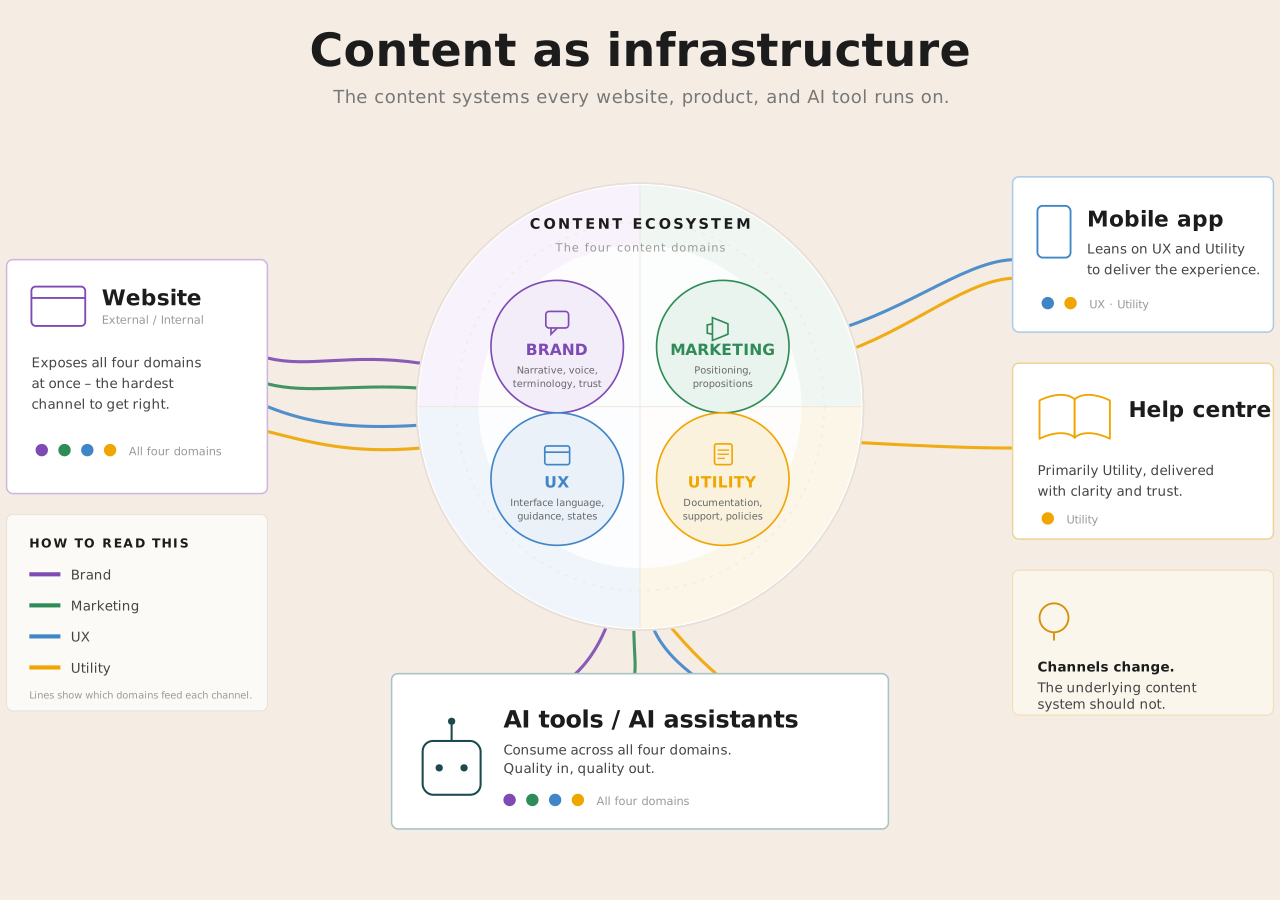
The designed system feeds every channel and platform – the same governed source content, drawn on wherever the organisation needs reliable content.
Where AI is in scope, operationalisation deepens into machine-operable context: retrieval logic, source-priority rules, evaluation criteria, context wrappers, and operating boundaries.
Start with the content system, not the next tool.
A free 30-minute conversation about what your current content can support, what it cannot, and where the next investment is carrying risk. No pitch.